White noise for a nursery is one of the most common sleep-training tools parents reach for, and one of the easiest to get wrong in a way that is invisible in the moment. A machine that sounds “not that loud” to an adult ear across the room can be considerably louder right where a baby’s head actually is. Here is what pediatric hearing guidance generally recommends, and what actually changes in a nursery over time that a fixed machine can’t account for.
This is general safety information, not medical advice. For guidance specific to your baby, talk to your pediatrician.
How loud is too loud for a nursery
Pediatric hearing guidance commonly recommends keeping nursery sound machines under about 50 decibels — roughly the volume of a quiet conversation — measured from where the baby’s ears actually are, not from across the room. Infant hearing is more sensitive to sustained loud sound than adult hearing, and a machine left at a high volume for an entire night is a very different exposure than the same volume for a few minutes.
The volume that feels right to a tired adult standing across the room is not a reliable guide. If you can comfortably hold a conversation over it standing next to the crib, it is likely too loud.
Placement matters as much as the volume dial
Commonly cited guidance suggests placing sound machines at least seven feet from the crib, rather than clipped to the rail or set on a nearby shelf right above the baby’s head. Distance drops volume fast — a machine that measures safely at seven feet can be considerably louder at seven inches. If your nursery is small, that often means turning the volume down further than you would in a larger room, not skipping the distance guidance.
A nursery’s acoustics do not stay the same
A nursery set up for a newborn is rarely the same room six months later. A rug gets added, furniture shifts, the crib moves away from a shared wall, a closet fills with clothes. Every one of those changes how sound behaves in the room — and a sound machine tuned once, at setup, has no way to know the room around it has changed.
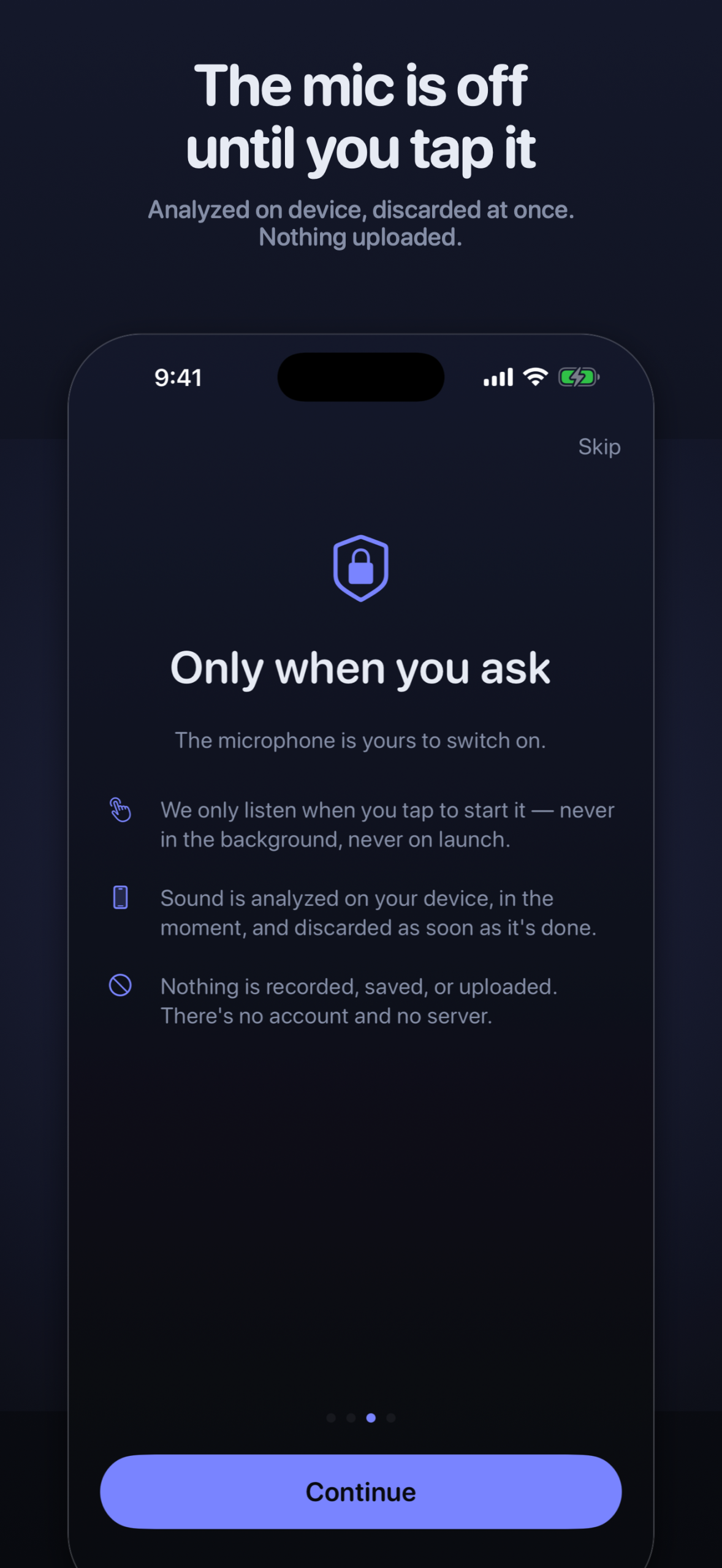
This is exactly the kind of drift RoomTone’s Match My Room is built for: a five-second microphone read of the room, any time you want to re-check it, rather than a volume dial set once and left alone for a year.
What to actually look for in a nursery sound app
- A volume that starts low by default, not maxed out the first time you open it.
- Some way to see what you are actually working with, instead of guessing by ear at 3am.
- A sleep timer with a gentle fade, rather than a hard stop that can startle a light sleeper.
- Nothing that requires an account, login, or app store purchase flow while you are standing in a dark room trying not to wake anyone up.
RoomTone’s Match My Room shows a live spectrum of what the microphone is picking up while it listens, so you are looking at something real rather than guessing at a volume knob. The full nine-sound library, sleep timer, and background playback are free permanently — no account, no trial clock, nothing to set up before the first night.
Try RoomTone and re-check the nursery’s acoustics anytime the room changes — not just on the night you set it up.
Again: this is general safety information, not a substitute for advice from your pediatrician or an audiologist about your baby specifically.
Frequently asked questions
Is white noise safe for babies to sleep with every night?
Pediatric guidance generally supports white noise as a normal part of a baby’s sleep routine, provided it is kept at a safe volume and distance. Keep the sound under 50 decibels measured from where the baby’s head will be, and place the device at least seven feet from the crib rather than inside it.
How loud should white noise be for a nursery?
Under 50 decibels from the crib — quieter than a normal conversation. Placing the machine across the room rather than on the nightstand next to the crib is usually enough to bring a loud device into a safer range without losing its effect.
Should white noise run all night for a baby?
Many parents run it continuously through the night, since a sound that starts and stops can itself become a waking cue. If you do run it all night, the volume and distance guidance above matters more, since it is a much longer nightly exposure than a sound that only plays at bedtime.