Blog

  • RoomTone vs. BetterSleep vs. Endel: What’s Actually Different

    RoomTone vs. BetterSleep vs. Endel: What’s Actually Different

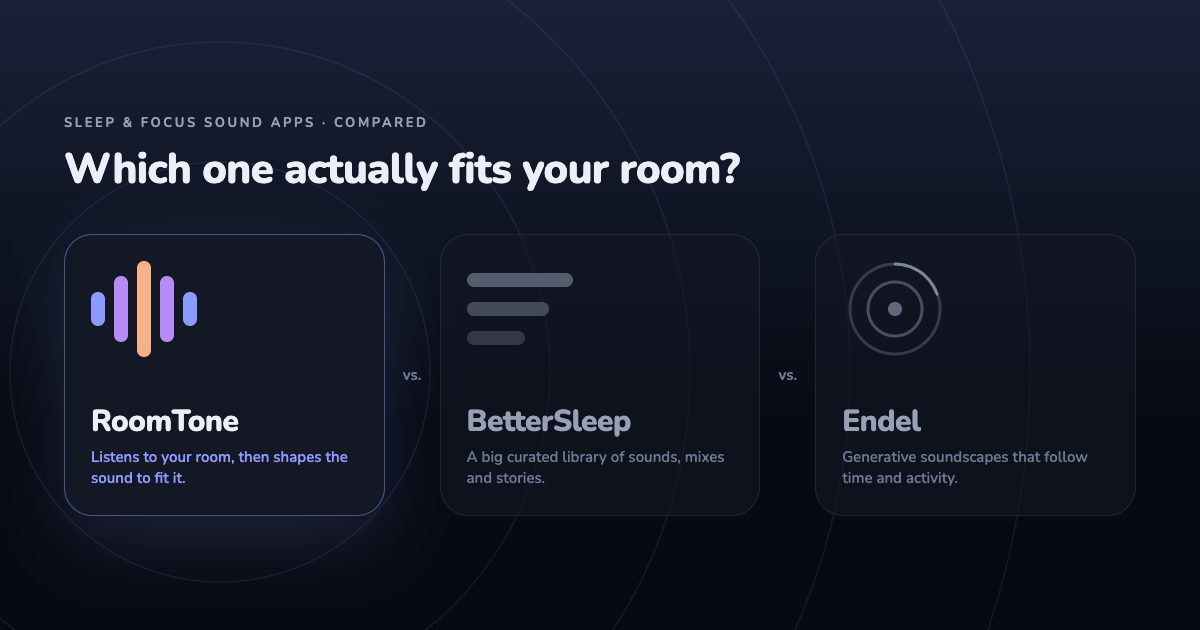
    If you are choosing between RoomTone, BetterSleep, and Endel, they are not really competing on the same thing. BetterSleep is a broad sleep-and-wellness app with a large content library. Endel personalizes sound to you — your location, the time of day, sometimes your heart rate. RoomTone does neither of those things; it measures the room you are actually in. Here is an honest look at where each one is actually stronger.

    What each app is actually built around

     RoomToneBetterSleepEndel
    Core ideaMeasures your room’s acoustics, matches or synthesizes sound to itLarge library of sounds, guided content, and sleep storiesGenerates soundscapes personalized to you — time, environment, sometimes biometrics
    Personalizes toThe room you’re in, remeasured anytime it changesYour own manual mix and preferencesYou — your context and, on supported plans, your body
    Where the analysis happensOn-device; audio is discarded immediately, nothing uploadedCloud-hosted content and account-based syncCloud-based generation using connected data
    Account requiredNo — no sign-in, no analytics SDKsYesYes
    Free tierFull 9-sound library, sleep timer, and background playback, free permanentlyLimited; most of the library sits behind subscriptionLimited free access; most soundscapes require a subscription
    Also offersSleep sounds only — one jobMeditation, sleep stories, sleep trackingFocus and relaxation modes beyond sleep
    Pricing$19.99/year or $2.99/month, first week freeVaries by promotion — check current pricing in-appVaries by plan and promotion — check current pricing in-app

    Where BetterSleep and Endel are genuinely stronger

    If you want guided meditations, sleep stories, or a sleep-tracking dashboard, BetterSleep’s library is much larger than anything RoomTone offers — RoomTone doesn’t attempt any of that. And if what appeals to you about Endel is sound that adapts to your day, your movement, or your heart rate, that is a genuinely different kind of personalization than RoomTone does, and Endel is built specifically for it. Neither of those is a gap RoomTone is trying to fill.

    Where RoomTone is different

    RoomTone’s personalization is aimed at something neither competitor measures directly: the room itself. Match My Room listens for five seconds and either points you to the closest match in the library or synthesizes a sound shaped to your room’s actual acoustic profile — on-device, with nothing uploaded and no account required. The full sound library stays free permanently, with no trial clock counting down in the background.

    If what you want is one thing done well — sound that is actually shaped to the room you sleep in — that is the whole app, not a feature buried in a broader wellness platform.

    Try RoomTone free and hear the difference room-matched sound actually makes.
  • Does White Noise Help with Tinnitus?

    Does White Noise Help with Tinnitus?

    Sound masking is one of the most commonly used coping strategies for tinnitus, and one of the most inconsistently explained. It is not a treatment and it does not make tinnitus go away — but for many people, the right background sound makes the ringing considerably less noticeable, especially at night when there is nothing else competing for attention.

    This is general information, not medical advice. If ringing in your ears is new, sudden, one-sided, or getting worse, see an audiologist or doctor rather than relying on masking sound alone.

    How sound masking actually works

    Tinnitus tends to stand out most in silence, because there is nothing else for your attention to land on. Audiologists commonly describe masking as introducing a broad, steady background sound that reduces the contrast between the ringing and total quiet — not by canceling the tinnitus itself, but by giving your attention something else to settle on. This is why masking is widely used as a coping tool, particularly at bedtime, even though it does not address the underlying cause.

    Which sound actually helps varies by person

    Tinnitus is not one fixed sound. Some people describe a high-pitched whine, others a lower hum, and the pitch that bothers you most is not the same for everyone. That is why sound recommendations for tinnitus vary so much between sources: broadband sound like white or pink noise covers a wide range and works for many people, while others find a deeper, low-frequency sound like brown noise or a fan more effective if their tinnitus sits higher in pitch. There is no single “best” sound for tinnitus — there is the one that happens to cover what you are hearing.

    Why one fixed sound loop often falls short

    Most sleep-sound apps hand you a small, fixed set of loops and leave you to guess which one helps. Given how much tinnitus pitch varies person to person, that is closer to a coin flip than a solution — and if the first sound you try does not help, many people conclude masking “doesn’t work for them,” when really they just tried the wrong sound.

    RoomTone gives each of its nine sounds five tonal takes running from deep rumble to bright, so trying a genuinely different shade of a sound does not mean downloading a different app or hunting through a long list — it is closer to adjusting a tone control until something actually covers what you are hearing.

    Try RoomTone and find the tone that actually matches what you hear, instead of settling for whichever generic loop came first.

    Again: sound masking is a coping strategy some people find helpful, not a treatment for tinnitus. If tinnitus is affecting your daily life, an audiologist can help identify the cause and the options that fit your situation specifically.

    Frequently asked questions

    Does white noise actually help tinnitus?

    Sound masking is a widely used coping strategy for tinnitus — many people find that a broad, steady background sound makes the ringing less noticeable, especially at night. It does not treat or cure tinnitus; it changes what your attention settles on.

    What’s the best sound for tinnitus, white noise or brown noise?

    It depends on the pitch of your tinnitus. Broadband white or pink noise covers a wide range and helps many people, while brown noise’s deeper, lower-frequency sound helps others, particularly if their tinnitus sits higher in pitch. There is no single best sound — matching the sound to what you actually hear matters more than the label on it.

    Can white noise make tinnitus worse?

    Used at a reasonable volume — around or just above the loudness of the ringing, not louder — sound masking does not damage hearing or make tinnitus worse. Playing any sound too loud for too many hours can contribute to hearing strain over time, which is why volume and duration matter more than the specific sound you choose.

  • How Loud Should White Noise Be for Sleep?

    How Loud Should White Noise Be for Sleep?

    Short answer first: for an adult bedroom, most guidance points to roughly 50–60 decibels — about as loud as a shower running in the next room. For a nursery, keep it under 50 decibels, measured from where the baby’s ears actually are. For a shared office or focus space, up to about 60–65 decibels is generally fine since you are awake and can adjust it yourself. Here is the reasoning behind those ranges, and how to actually check instead of guessing.

    Why the volume matters more than people think

    Too quiet, and white noise does not do its job — it sits below whatever you are trying to mask instead of covering it. Too loud, and you have traded one sleep problem for a smaller but real hearing-health one, especially since sleep sound machines often run at a steady volume for six to eight hours straight, every night. A volume that would be completely fine for twenty minutes is a different exposure across an entire night, every night, for months.

    A quick reference by room

    • Adult bedroom: roughly 50–60 decibels, ideally measured a few feet from your head, not from across the room.
    • Nursery or baby’s room: under 50 decibels, from at least seven feet away from the crib — see the fuller nursery safety guide for placement details.
    • Office or focus space: up to about 60–65 decibels is generally reasonable, since you are awake, alert, and can turn it down if it starts to bother you.

    These are reasonable starting ranges, not hard limits enforced by anyone. If a sound ever feels uncomfortably loud, that discomfort is a more reliable signal than any number on a page.

    How to actually check, instead of guessing

    Almost nobody measures their white noise machine with an actual decibel meter, which means almost everyone is setting volume by feel — and by the time a sound feels “too loud” to a tired adult, it has often been too loud for a while. A phone-based sound meter app is one option if you want an exact number.

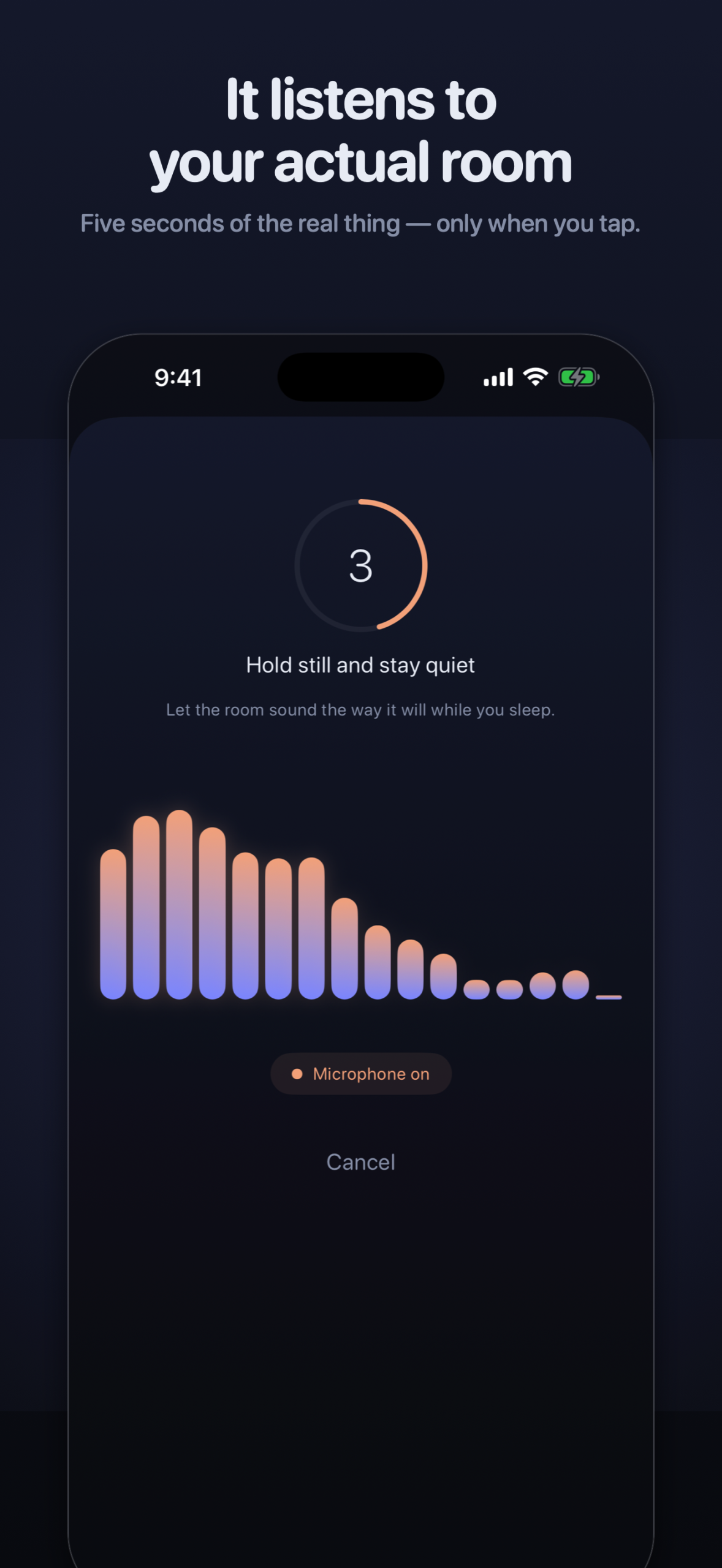
    RoomTone takes a different angle on the same problem: Match My Room shows you a live spectrum of what the microphone is actually picking up while it listens, so you are looking at real information about your room instead of turning a dial and hoping. It won’t replace a calibrated meter if you need an exact decibel figure, but it replaces pure guesswork with something you can actually see.

    Try RoomTone and see what your room is actually doing, instead of guessing at a volume slider in the dark.

    Frequently asked questions

    What decibel level is safe for white noise while sleeping?

    For an adult bedroom, roughly 50–60 decibels is a reasonable range — about as loud as a shower running in the next room. For a nursery, keep it under 50 decibels, measured from where the baby’s ears actually are.

    Can white noise damage your hearing?

    At a moderate volume used for masking, there is no evidence of hearing damage. The real risk comes from running any sound too loud for many hours every night, since sound machines often play for six to eight hours straight — a volume that is fine for twenty minutes is a different exposure across an entire night.

    How do I know if my white noise machine is too loud?

    If turning it down does not noticeably reduce how well it covers other sounds, or if the sound itself feels uncomfortable, it is likely too loud. A phone-based decibel meter app can give you an exact reading if you want to check it against the ranges above.

  • White Noise for Baby Sleep: A Parent’s Safety Guide

    White Noise for Baby Sleep: A Parent’s Safety Guide

    White noise for a nursery is one of the most common sleep-training tools parents reach for, and one of the easiest to get wrong in a way that is invisible in the moment. A machine that sounds “not that loud” to an adult ear across the room can be considerably louder right where a baby’s head actually is. Here is what pediatric hearing guidance generally recommends, and what actually changes in a nursery over time that a fixed machine can’t account for.

    This is general safety information, not medical advice. For guidance specific to your baby, talk to your pediatrician.

    How loud is too loud for a nursery

    Pediatric hearing guidance commonly recommends keeping nursery sound machines under about 50 decibels — roughly the volume of a quiet conversation — measured from where the baby’s ears actually are, not from across the room. Infant hearing is more sensitive to sustained loud sound than adult hearing, and a machine left at a high volume for an entire night is a very different exposure than the same volume for a few minutes.

    The volume that feels right to a tired adult standing across the room is not a reliable guide. If you can comfortably hold a conversation over it standing next to the crib, it is likely too loud.

    Placement matters as much as the volume dial

    Commonly cited guidance suggests placing sound machines at least seven feet from the crib, rather than clipped to the rail or set on a nearby shelf right above the baby’s head. Distance drops volume fast — a machine that measures safely at seven feet can be considerably louder at seven inches. If your nursery is small, that often means turning the volume down further than you would in a larger room, not skipping the distance guidance.

    A nursery’s acoustics do not stay the same

    A nursery set up for a newborn is rarely the same room six months later. A rug gets added, furniture shifts, the crib moves away from a shared wall, a closet fills with clothes. Every one of those changes how sound behaves in the room — and a sound machine tuned once, at setup, has no way to know the room around it has changed.

    This is exactly the kind of drift RoomTone’s Match My Room is built for: a five-second microphone read of the room, any time you want to re-check it, rather than a volume dial set once and left alone for a year.

    What to actually look for in a nursery sound app

    • A volume that starts low by default, not maxed out the first time you open it.
    • Some way to see what you are actually working with, instead of guessing by ear at 3am.
    • A sleep timer with a gentle fade, rather than a hard stop that can startle a light sleeper.
    • Nothing that requires an account, login, or app store purchase flow while you are standing in a dark room trying not to wake anyone up.

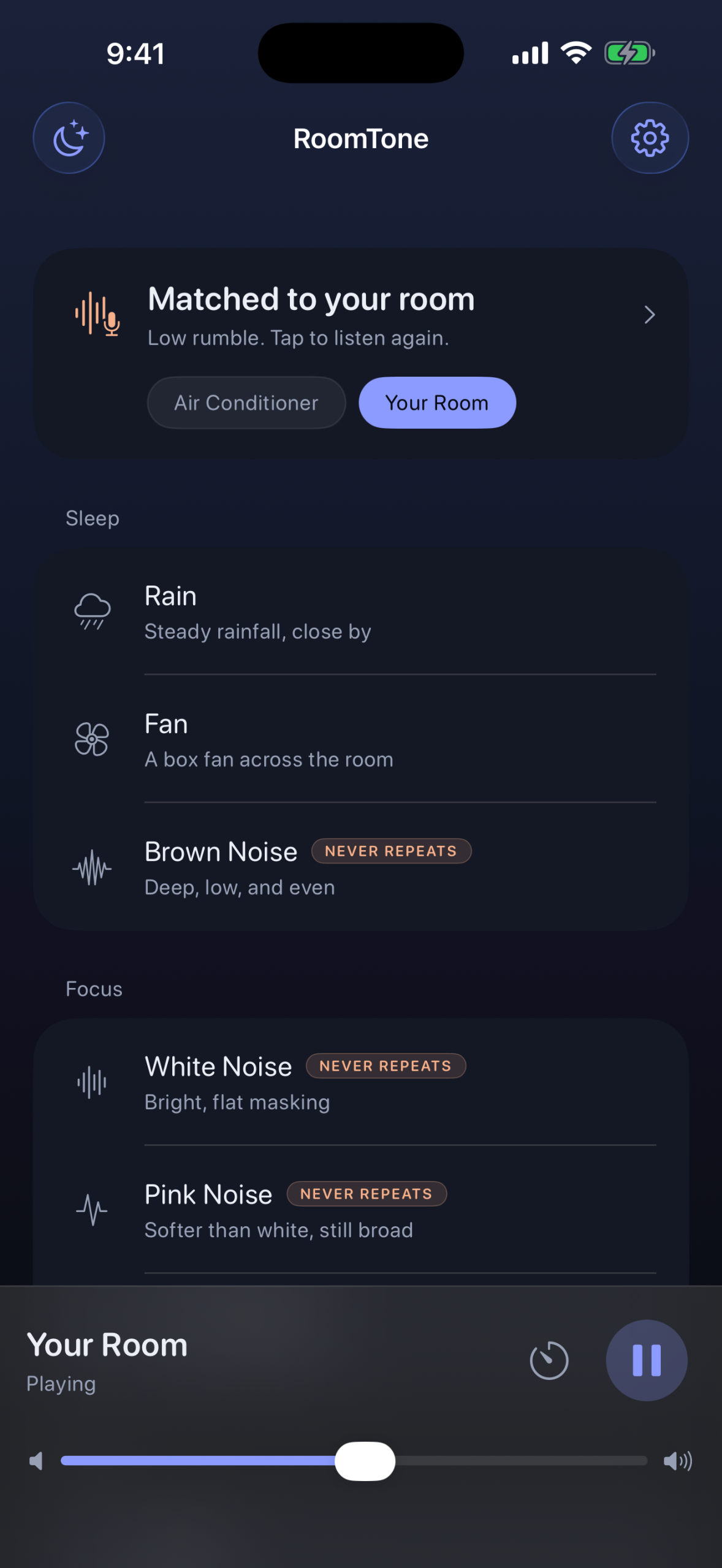
    RoomTone’s Match My Room shows a live spectrum of what the microphone is picking up while it listens, so you are looking at something real rather than guessing at a volume knob. The full nine-sound library, sleep timer, and background playback are free permanently — no account, no trial clock, nothing to set up before the first night.

    Try RoomTone and re-check the nursery’s acoustics anytime the room changes — not just on the night you set it up.

    Again: this is general safety information, not a substitute for advice from your pediatrician or an audiologist about your baby specifically.

    Frequently asked questions

    Is white noise safe for babies to sleep with every night?

    Pediatric guidance generally supports white noise as a normal part of a baby’s sleep routine, provided it is kept at a safe volume and distance. Keep the sound under 50 decibels measured from where the baby’s head will be, and place the device at least seven feet from the crib rather than inside it.

    How loud should white noise be for a nursery?

    Under 50 decibels from the crib — quieter than a normal conversation. Placing the machine across the room rather than on the nightstand next to the crib is usually enough to bring a loud device into a safer range without losing its effect.

    Should white noise run all night for a baby?

    Many parents run it continuously through the night, since a sound that starts and stops can itself become a waking cue. If you do run it all night, the volume and distance guidance above matters more, since it is a much longer nightly exposure than a sound that only plays at bedtime.

  • The Best Sounds for Deep Sleep, and Why Each One Works

    The Best Sounds for Deep Sleep, and Why Each One Works

    “Best sound for sleep” lists usually rank recordings against each other as if one universally wins. It does not work that way — the sound that helps you fall asleep is the one that covers whatever your specific room is doing at 11pm, whether that is traffic, a hallway, or just restless silence. Here are the nine sounds worth knowing, grouped by what they are actually good at, and why each one works the way it does.

    Natural sounds: familiar, easy to tune out

    These work because your brain already knows how to ignore them — steady, natural sound rarely signals something worth waking up for.

    • Rain — steady rainfall, close by. Broad-spectrum and even, which makes it one of the more versatile masking sounds for a mixed-noise room.
    • Ocean — slow, rolling surf. The rise and fall is rhythmic rather than flat, which some people find easier to settle into than a completely uniform sound.
    • Stream — moving water over rock. Sits brighter than rain or ocean, useful in a room where the noise you are covering is higher-pitched.
    • Night Air — the ambient hush of being outside after dark. The most subtle sound in the library — better suited to a genuinely quiet room than a loud one.

    Mechanical sounds: steady, familiar, unremarkable

    Fan and AC sounds work for a simple reason: most people have already fallen asleep to one, in real life, more than once.

    • Fan — a box fan across the room. Mid-weighted and constant, a dependable default when you are not sure what else to try.
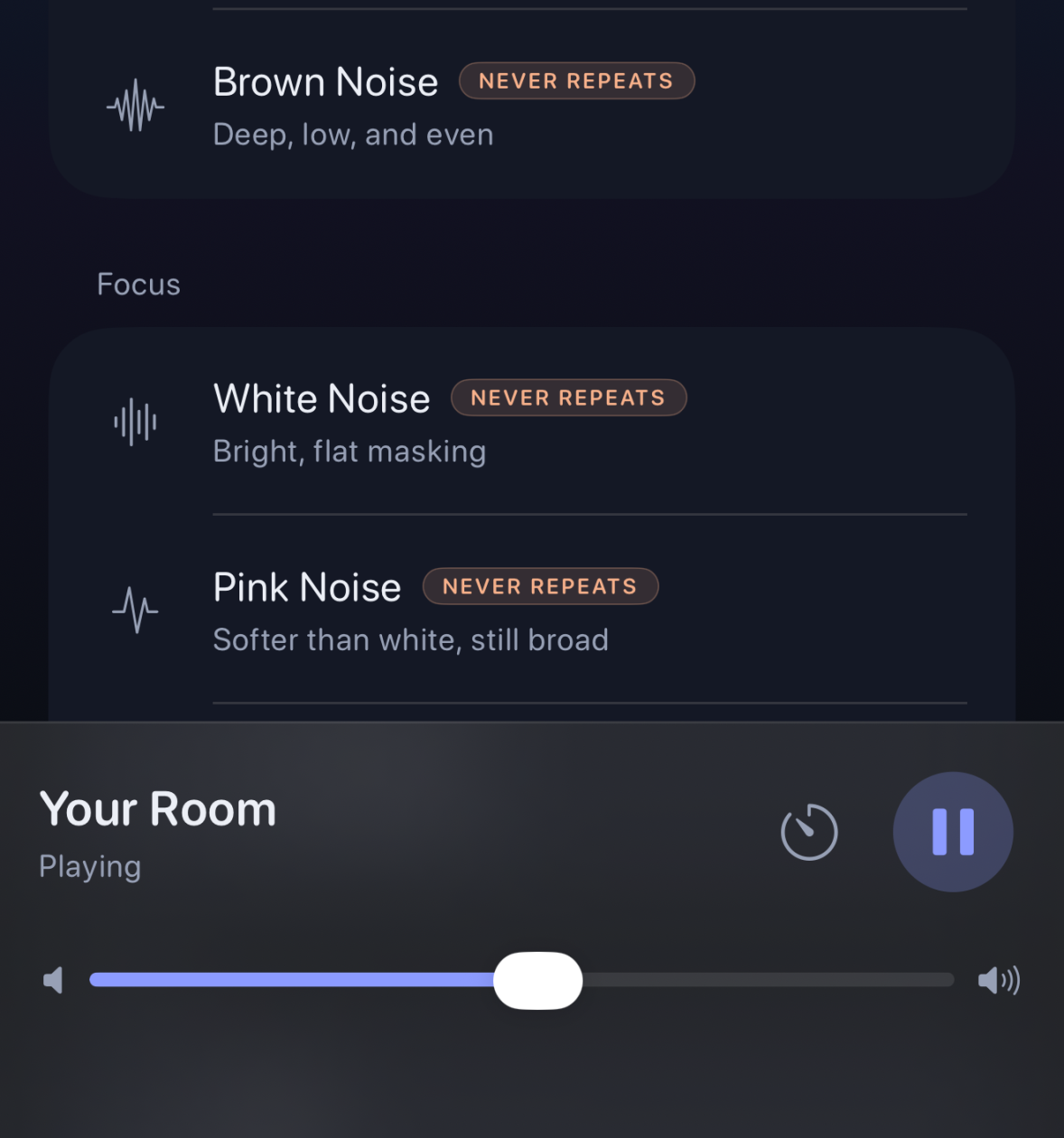
    • Air Conditioner — a deep, steady hum. Runs lower than the fan, closer to brown noise’s rumble than white noise’s hiss.

    Pure noise colors: tunable, not tied to a recording

    Unlike the sounds above, these are not recordings of anything — they are synthesized noise, which means RoomTone can generate them live instead of looping a fixed take.

    • Brown Noise — deep, low, and even. The most rumble-heavy option, good for masking traffic or HVAC noise specifically.
    • Pink Noise — softer than white, still broad. A middle ground between brown’s depth and white’s brightness.
    • White Noise — bright, flat masking. The widest frequency coverage of the three, best for inconsistent or unpredictable noise.

    Read the fuller breakdown of brown vs. pink vs. white noise if you want the frequency science behind these three specifically.

    Why “which is best” is the wrong question

    Every one of these nine sounds is genuinely the right answer for someone — just not for the same room. A rumble-heavy room near a busy street gets more out of Brown Noise or Air Conditioner. A quiet room with occasional sharp sounds does better with something broader, like Rain or White Noise. That is also why RoomTone gives each recorded sound five takes running from deep rumble to bright, rather than treating each one as a single fixed loop — the “right” sound and the right shade of it are two different decisions.

    All nine sounds are free, permanently, with five takes each — try them tonight, or let Match My Room point you at the one built for your specific room.

  • Brown Noise vs. White Noise vs. Pink Noise: Which Actually Helps You Sleep

    Brown Noise vs. White Noise vs. Pink Noise: Which Actually Helps You Sleep

    Search this question and you will get a confident, different answer every time: brown noise is best, no wait, pink noise is what sleep researchers actually recommend, no wait, white noise is the only one that really masks anything. The honest answer is less satisfying and more useful: it depends on what you are trying to cover up, and none of them are being tuned to your actual room.

    Here is what each one is, what it is actually good at, and why the “best” one is a moving target.

    What “color” actually means

    Noise color describes how energy is spread across frequencies, from deep rumble to high hiss.

    • White noise spreads energy equally across every frequency. It is the brightest and hissiest of the three — think old TV static.
    • Pink noise reduces energy as frequency rises, roughly matching how human hearing is weighted. It reads as softer and fuller than white, closer to steady rainfall.
    • Brown noise (sometimes “red noise”) drops off even more steeply, concentrating energy in the low end. It reads as a deep rumble — closer to distant thunder or a jet cabin.

    None of these are recordings of anything. They are mathematically defined noise — the “color” naming borrows from how light spectra work, not from anything you can see.

    White noise: broad coverage, less subtle

    White noise’s flat spread across every frequency makes it effective at masking a wide range of sudden or inconsistent sounds — a partner’s snoring, a dog barking outside, city noise that changes pitch. The tradeoff is the same flatness: some people find the brightness fatiguing over a full night, especially in a quiet, absorbent room where there is little to mask in the first place.

    Pink noise: the balanced middle

    Pink noise is the one most often cited in sleep-and-memory research, largely because its frequency balance is closer to naturally occurring sound (rainfall, wind, steady surf) than white noise’s synthetic hiss. It tends to feel less harsh for extended listening, while still covering a reasonably wide frequency range.

    Brown noise: deep and steady

    Brown noise’s low-frequency emphasis makes it well suited to masking rumble-heavy noise — traffic through a window, an HVAC system, a neighbor’s bass. It is also the noise color that has picked up the most attention online recently, often described as feeling more “grounding” than white noise’s higher pitch. That is a real, common preference, not a universal rule.

    So which one is actually best?

    The honest answer is that it depends on two things that have nothing to do with which color is objectively superior: what you are trying to mask, and what your room does to sound before it reaches your ear. A rumble-heavy room with traffic outside will get more out of brown noise’s low-end coverage. A room with a hissy, high-pitched HVAC vent will need something closer to white. A generally quiet room might do best with pink noise’s gentler middle ground.

    This is also why so many people try one noise color, find it does not work, and give up on masking sound entirely — they tried the wrong shade for their specific room, not the wrong idea.

    A better way to choose than guessing

    Instead of guessing among three fixed options, RoomTone treats noise color as a dial rather than a decision. Every sound in the library — including Brown, Pink, and White Noise — comes with five takes running from deep rumble to bright, so picking a color is closer to adjusting a tone control than committing to one of three loops. Play a take, nudge it warmer or brighter, and land on whatever actually covers your room’s noise.

    Or skip the trial and error: Match My Room listens to your room for five seconds and either points you to the closest take in the library or synthesizes a custom mask shaped to what it measured — already positioned on the rumble-to-bright scale your room actually needs, instead of leaving you to guess between three colors on a page.

    All nine sounds, five takes each, are free — try the tone that matches your room instead of picking a color at random.

    Frequently asked questions

    What’s the difference between white noise, pink noise, and brown noise?

    They differ in which frequencies are loudest. White noise has equal energy across all frequencies and sounds the brightest and hissiest. Pink noise reduces the higher frequencies, sounding softer and closer to rain. Brown noise reduces high frequencies even further, producing a deep, low rumble like a waterfall.

    Which noise color is best for sleep?

    There is no universal winner — it depends on what you are trying to mask and your own preference. Pink and brown noise are often described as more soothing for sleep because they are less harsh than white noise, but white noise covers a broader range of intrusive sounds, like a partner’s snoring or street noise.

    Is brown noise better than white noise for focus or sleep?

    Some people find brown noise’s deeper tone easier to relax into, but “better” really comes down to which sound covers the specific noise bothering you and which one you personally find pleasant — that is subjective and varies from person to person.

  • Why the Same White Noise Sounds Different in Every Bedroom

    Why the Same White Noise Sounds Different in Every Bedroom

    Download the same white noise app your friend swears by, play the same rain loop at the same volume, and it will not sound the same in your bedroom as it does in theirs. That is not in your head. Two rooms rarely handle sound the same way, and a fixed loop has no way to adjust for the room it happens to be playing in.

    Here is what is actually going on, and what it takes to fix it properly.

    A room is not a neutral speaker

    Every bedroom reshapes whatever sound plays inside it. Hard surfaces — glass, plaster, a bare floor — reflect sound back into the room, so high frequencies linger and the room reads as bright or “hissy.” Soft surfaces — carpet, curtains, a stacked closet of clothes — absorb those same frequencies, so a room full of soft furniture swallows the top end of a sound and leaves the low rumble to do all the work.

    Room size and shape matter just as much. A small bedroom with a low ceiling builds up bass differently than a large room with high ceilings and a lot of open air. Furniture placement, how close you sleep to a window, whether there is a hallway or a stairwell nearby — all of it changes what a sound actually sounds like by the time it reaches your ear.

    None of this is exotic. It is the same reason a voice memo recorded in your bathroom sounds different from one recorded in your living room. Rooms have their own acoustic signature. White noise is no exception to that; it just rarely gets treated like it.

    It is not only about volume

    The usual fix people reach for is turning the sound up or down. That helps with loudness, but loudness was rarely the actual problem. If your room’s noise — traffic through a window, a hallway, an old HVAC vent — sits mostly in a low rumble, a bright, hissy white noise loop has to work much harder to cover it, and often just sits on top of it instead of masking it. If your room is naturally quiet and absorbent, a loop built for a echo-y room can sound thin and distant no matter how loud you play it.

    Masking sound works by covering the frequencies of whatever you are trying to block out. A sound that does not share those frequencies is not really doing the job, regardless of volume.

    Your room does not stay the same, either

    Even once you find a sound that works, the room underneath it keeps changing. A space heater turns on for the season. You move a bookshelf. You travel and the hotel room has none of the soft furniture your bedroom does. Every one of those changes the room’s acoustic profile a little, and a loop that was tuned to your old setup — if it was ever tuned to anything at all — has no way to know that.

    What it actually takes to fix this

    Fixing it properly means measuring the room, not guessing at it. That is the entire premise behind RoomTone’s Match My Room feature: tap once, and the app listens to your actual room for five seconds through the microphone, showing a live spectrum of what it is hearing in real time. That is real analysis of real audio, not a canned animation.

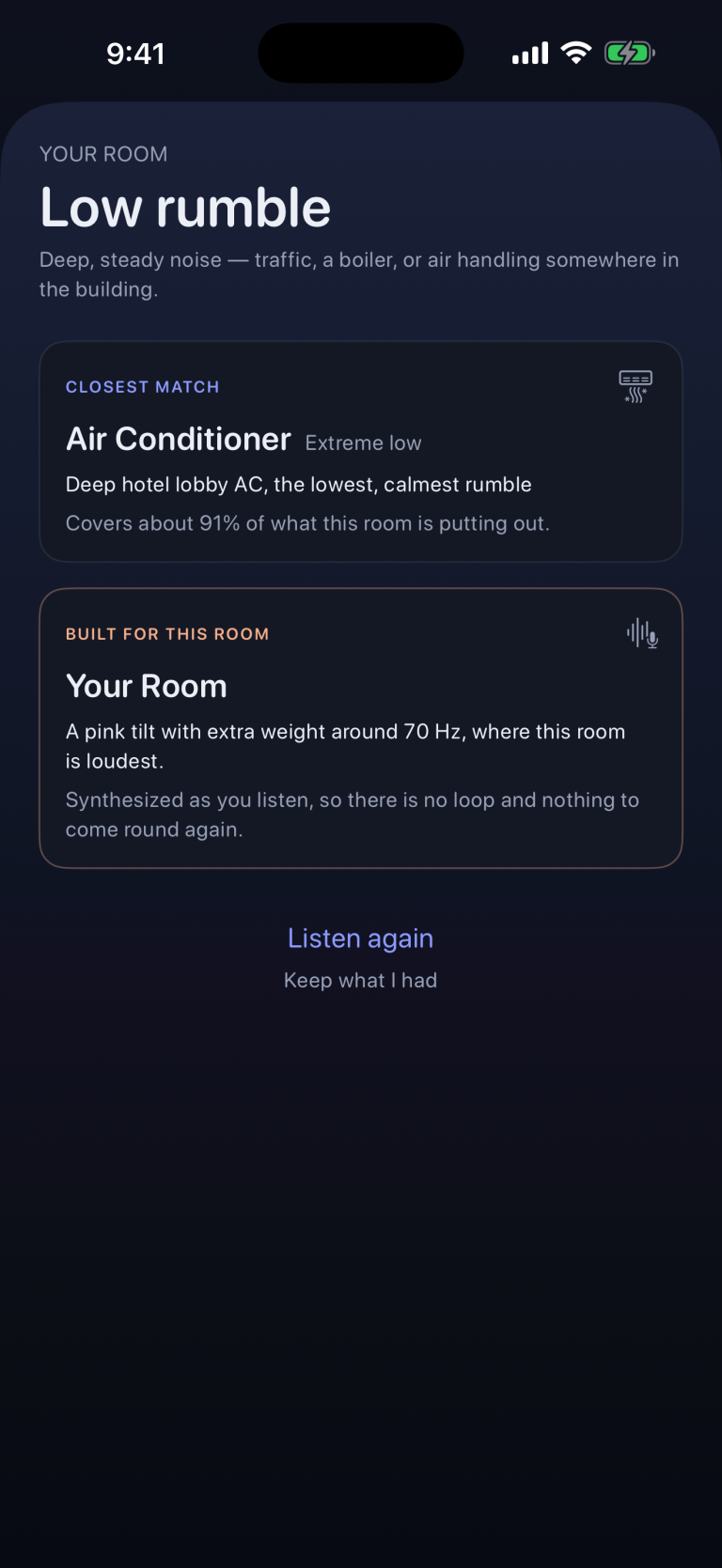
    A few seconds later, you get two options built from that measurement:

    • Closest Match — the recording from RoomTone’s library whose frequencies best cover what your room measured, scored against every take of every sound.
    • Custom Match — noise generated live and shaped to your room’s measured spectrum. It is synthesized on the spot, not a loop, so it never repeats.
    RoomTone results screen comparing a Closest Match library recording to a Custom Match synthesized for the room
    A room reading of “low rumble” here, an air conditioner recording, and a synthesized match — for that same room.

    Play whichever one actually sounds right, and re-match any time the room changes — a fan goes off, the season turns, you are sleeping somewhere unfamiliar. The room gets measured again, not assumed to be the same as last time.

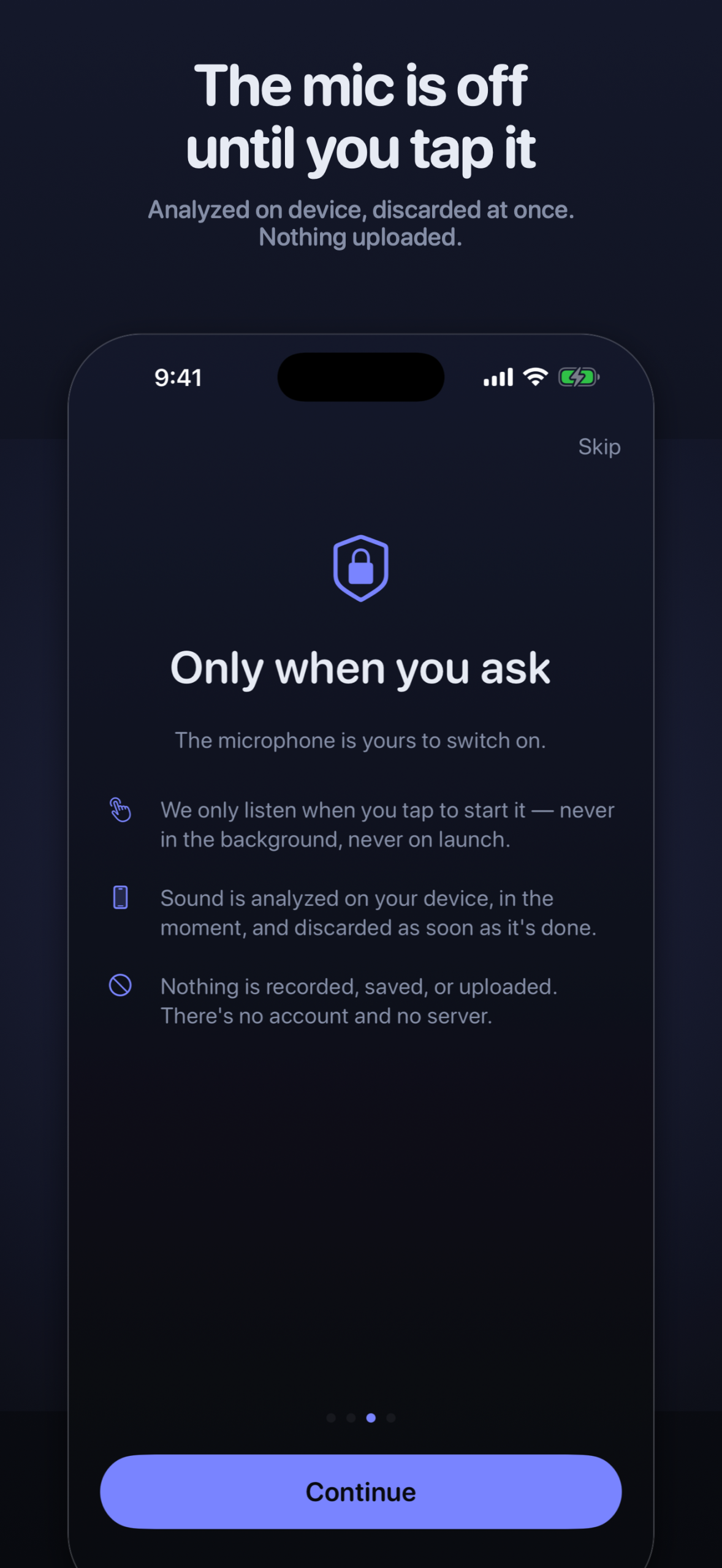
    It is also worth saying plainly what this does not involve: the microphone is only ever on when you tap the button, the audio is analyzed on-device and discarded immediately, and nothing is uploaded anywhere. The measurement exists for the five seconds it takes to shape your sound, and then it is gone.

    The room was always part of the equation

    A white noise loop is built once, in whatever room the recording engineer happened to be in, and then played back unchanged in every bedroom that downloads it. The mismatch between that room and yours is not a flaw in the recording — it is just a variable nobody accounted for. Measuring your actual room, instead of guessing at it, is the more obvious way to solve a problem that every fixed sound library runs into eventually.

    RoomTone listens to your room for five seconds before it plays anything — the full sound library is free, and Match My Room is worth trying tonight.