Download the same white noise app your friend swears by, play the same rain loop at the same volume, and it will not sound the same in your bedroom as it does in theirs. That is not in your head. Two rooms rarely handle sound the same way, and a fixed loop has no way to adjust for the room it happens to be playing in.
Here is what is actually going on, and what it takes to fix it properly.
A room is not a neutral speaker
Every bedroom reshapes whatever sound plays inside it. Hard surfaces — glass, plaster, a bare floor — reflect sound back into the room, so high frequencies linger and the room reads as bright or “hissy.” Soft surfaces — carpet, curtains, a stacked closet of clothes — absorb those same frequencies, so a room full of soft furniture swallows the top end of a sound and leaves the low rumble to do all the work.
Room size and shape matter just as much. A small bedroom with a low ceiling builds up bass differently than a large room with high ceilings and a lot of open air. Furniture placement, how close you sleep to a window, whether there is a hallway or a stairwell nearby — all of it changes what a sound actually sounds like by the time it reaches your ear.
None of this is exotic. It is the same reason a voice memo recorded in your bathroom sounds different from one recorded in your living room. Rooms have their own acoustic signature. White noise is no exception to that; it just rarely gets treated like it.
It is not only about volume
The usual fix people reach for is turning the sound up or down. That helps with loudness, but loudness was rarely the actual problem. If your room’s noise — traffic through a window, a hallway, an old HVAC vent — sits mostly in a low rumble, a bright, hissy white noise loop has to work much harder to cover it, and often just sits on top of it instead of masking it. If your room is naturally quiet and absorbent, a loop built for a echo-y room can sound thin and distant no matter how loud you play it.
Masking sound works by covering the frequencies of whatever you are trying to block out. A sound that does not share those frequencies is not really doing the job, regardless of volume.
Your room does not stay the same, either
Even once you find a sound that works, the room underneath it keeps changing. A space heater turns on for the season. You move a bookshelf. You travel and the hotel room has none of the soft furniture your bedroom does. Every one of those changes the room’s acoustic profile a little, and a loop that was tuned to your old setup — if it was ever tuned to anything at all — has no way to know that.
What it actually takes to fix this
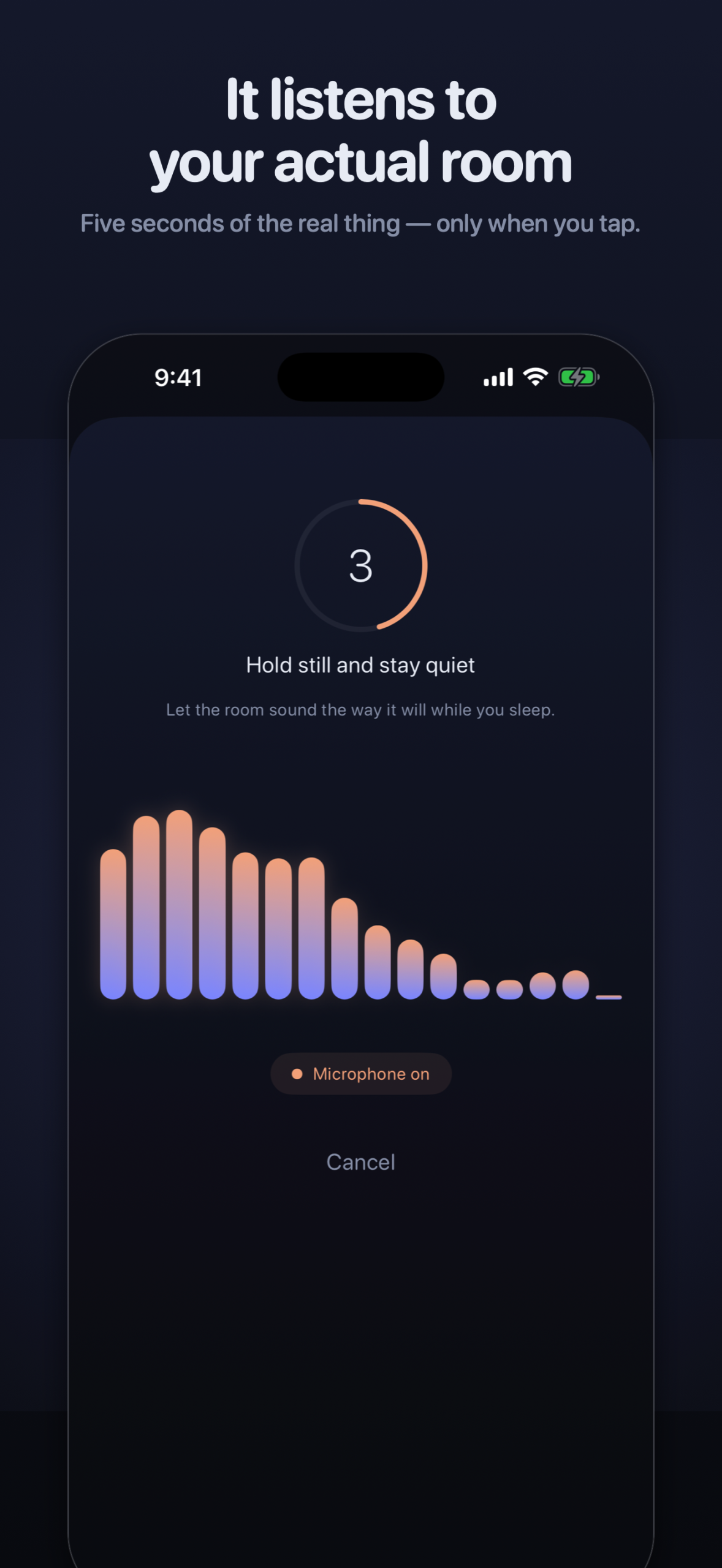
Fixing it properly means measuring the room, not guessing at it. That is the entire premise behind RoomTone’s Match My Room feature: tap once, and the app listens to your actual room for five seconds through the microphone, showing a live spectrum of what it is hearing in real time. That is real analysis of real audio, not a canned animation.
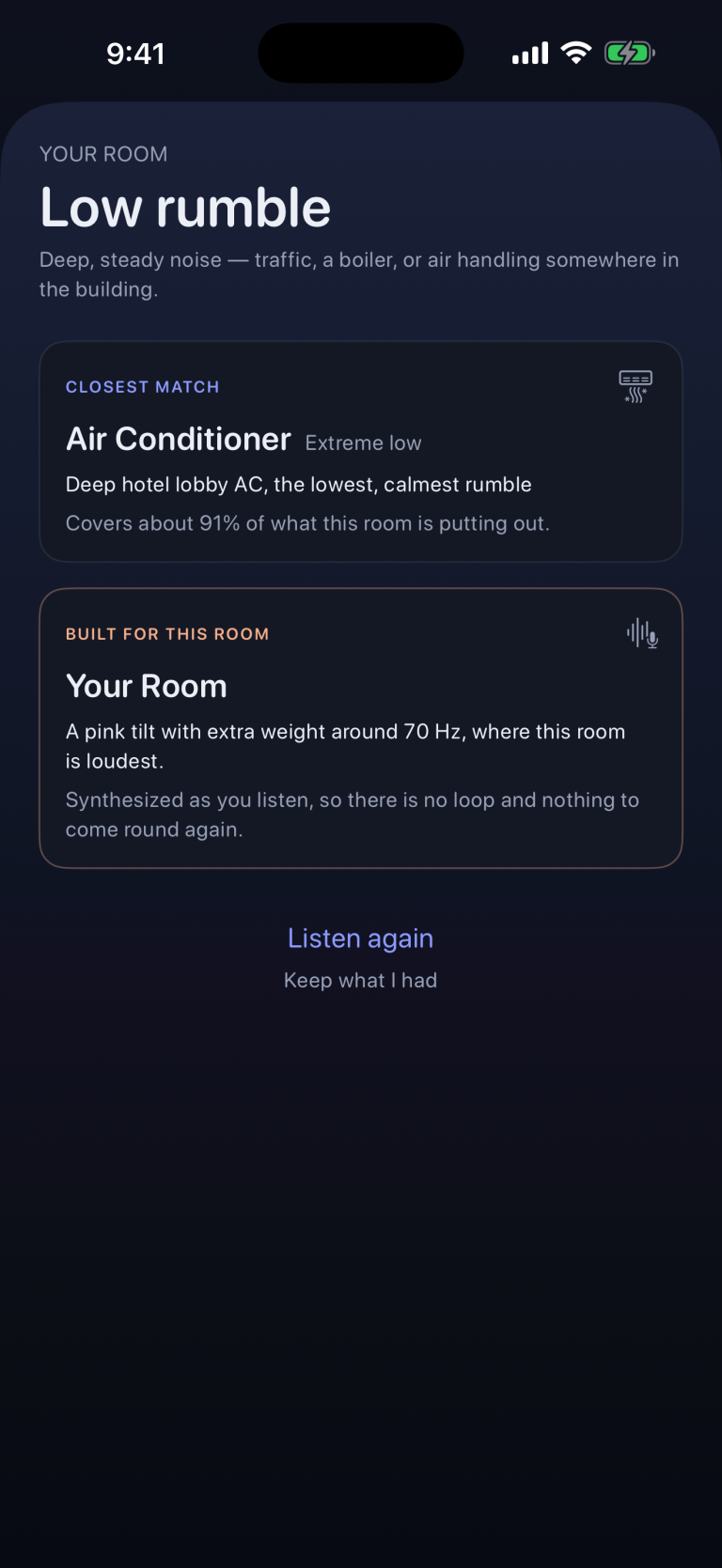
A few seconds later, you get two options built from that measurement:
- Closest Match — the recording from RoomTone’s library whose frequencies best cover what your room measured, scored against every take of every sound.
- Custom Match — noise generated live and shaped to your room’s measured spectrum. It is synthesized on the spot, not a loop, so it never repeats.
Play whichever one actually sounds right, and re-match any time the room changes — a fan goes off, the season turns, you are sleeping somewhere unfamiliar. The room gets measured again, not assumed to be the same as last time.
It is also worth saying plainly what this does not involve: the microphone is only ever on when you tap the button, the audio is analyzed on-device and discarded immediately, and nothing is uploaded anywhere. The measurement exists for the five seconds it takes to shape your sound, and then it is gone.
The room was always part of the equation
A white noise loop is built once, in whatever room the recording engineer happened to be in, and then played back unchanged in every bedroom that downloads it. The mismatch between that room and yours is not a flaw in the recording — it is just a variable nobody accounted for. Measuring your actual room, instead of guessing at it, is the more obvious way to solve a problem that every fixed sound library runs into eventually.
RoomTone listens to your room for five seconds before it plays anything — the full sound library is free, and Match My Room is worth trying tonight.