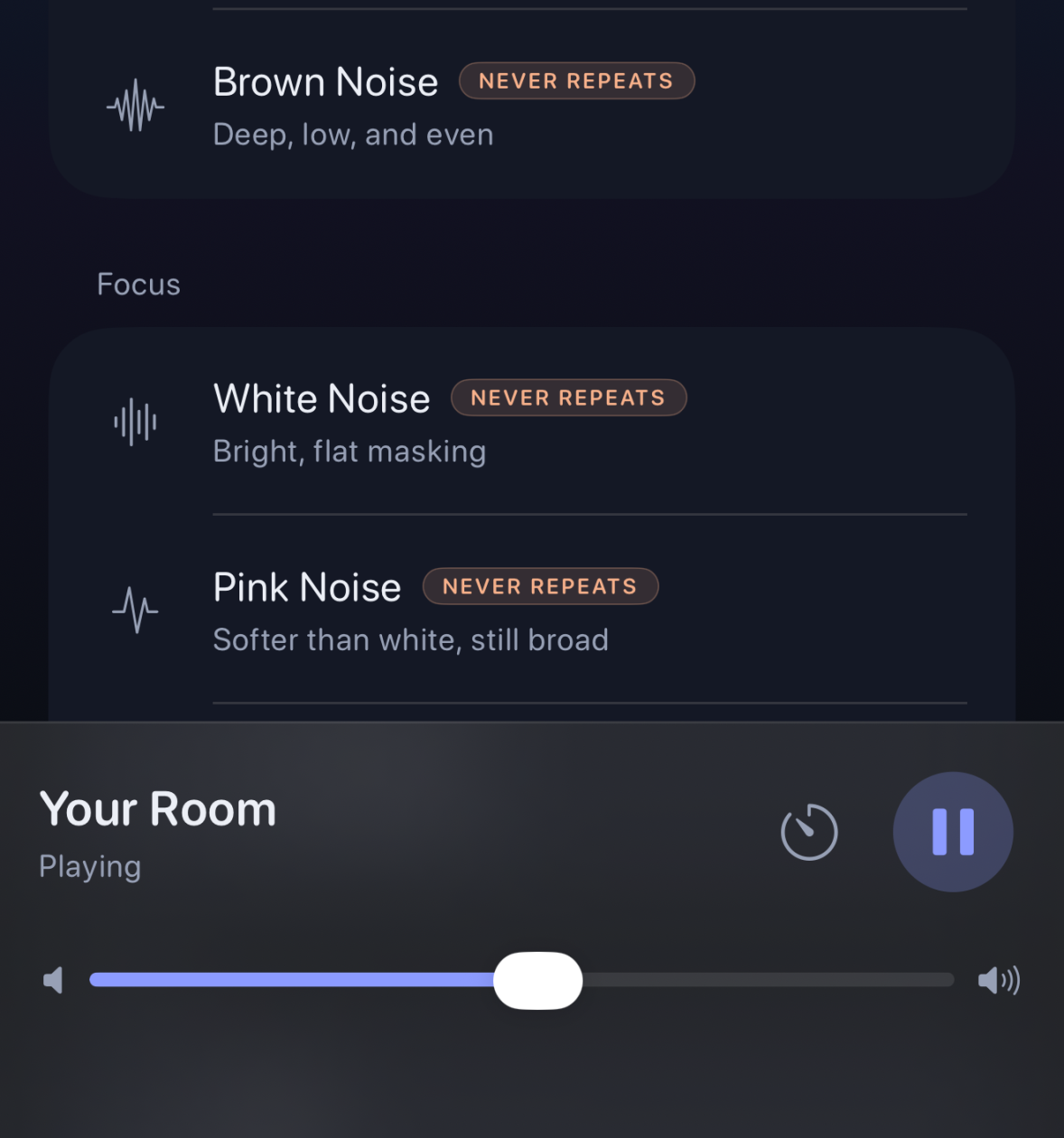
Search this question and you will get a confident, different answer every time: brown noise is best, no wait, pink noise is what sleep researchers actually recommend, no wait, white noise is the only one that really masks anything. The honest answer is less satisfying and more useful: it depends on what you are trying to cover up, and none of them are being tuned to your actual room.
Here is what each one is, what it is actually good at, and why the “best” one is a moving target.
What “color” actually means
Noise color describes how energy is spread across frequencies, from deep rumble to high hiss.
- White noise spreads energy equally across every frequency. It is the brightest and hissiest of the three — think old TV static.
- Pink noise reduces energy as frequency rises, roughly matching how human hearing is weighted. It reads as softer and fuller than white, closer to steady rainfall.
- Brown noise (sometimes “red noise”) drops off even more steeply, concentrating energy in the low end. It reads as a deep rumble — closer to distant thunder or a jet cabin.
None of these are recordings of anything. They are mathematically defined noise — the “color” naming borrows from how light spectra work, not from anything you can see.
White noise: broad coverage, less subtle
White noise’s flat spread across every frequency makes it effective at masking a wide range of sudden or inconsistent sounds — a partner’s snoring, a dog barking outside, city noise that changes pitch. The tradeoff is the same flatness: some people find the brightness fatiguing over a full night, especially in a quiet, absorbent room where there is little to mask in the first place.
Pink noise: the balanced middle
Pink noise is the one most often cited in sleep-and-memory research, largely because its frequency balance is closer to naturally occurring sound (rainfall, wind, steady surf) than white noise’s synthetic hiss. It tends to feel less harsh for extended listening, while still covering a reasonably wide frequency range.
Brown noise: deep and steady
Brown noise’s low-frequency emphasis makes it well suited to masking rumble-heavy noise — traffic through a window, an HVAC system, a neighbor’s bass. It is also the noise color that has picked up the most attention online recently, often described as feeling more “grounding” than white noise’s higher pitch. That is a real, common preference, not a universal rule.
So which one is actually best?
The honest answer is that it depends on two things that have nothing to do with which color is objectively superior: what you are trying to mask, and what your room does to sound before it reaches your ear. A rumble-heavy room with traffic outside will get more out of brown noise’s low-end coverage. A room with a hissy, high-pitched HVAC vent will need something closer to white. A generally quiet room might do best with pink noise’s gentler middle ground.
This is also why so many people try one noise color, find it does not work, and give up on masking sound entirely — they tried the wrong shade for their specific room, not the wrong idea.
A better way to choose than guessing
Instead of guessing among three fixed options, RoomTone treats noise color as a dial rather than a decision. Every sound in the library — including Brown, Pink, and White Noise — comes with five takes running from deep rumble to bright, so picking a color is closer to adjusting a tone control than committing to one of three loops. Play a take, nudge it warmer or brighter, and land on whatever actually covers your room’s noise.
Or skip the trial and error: Match My Room listens to your room for five seconds and either points you to the closest take in the library or synthesizes a custom mask shaped to what it measured — already positioned on the rumble-to-bright scale your room actually needs, instead of leaving you to guess between three colors on a page.
All nine sounds, five takes each, are free — try the tone that matches your room instead of picking a color at random.
Frequently asked questions
What’s the difference between white noise, pink noise, and brown noise?
They differ in which frequencies are loudest. White noise has equal energy across all frequencies and sounds the brightest and hissiest. Pink noise reduces the higher frequencies, sounding softer and closer to rain. Brown noise reduces high frequencies even further, producing a deep, low rumble like a waterfall.
Which noise color is best for sleep?
There is no universal winner — it depends on what you are trying to mask and your own preference. Pink and brown noise are often described as more soothing for sleep because they are less harsh than white noise, but white noise covers a broader range of intrusive sounds, like a partner’s snoring or street noise.
Is brown noise better than white noise for focus or sleep?
Some people find brown noise’s deeper tone easier to relax into, but “better” really comes down to which sound covers the specific noise bothering you and which one you personally find pleasant — that is subjective and varies from person to person.